


How to Create a Conceptual Artwork

Creating a conceptual artwork begins from within: with a clear idea and a strong intention. Everything revolves around meaning, while form becomes only a vehicle.
Formulate the Idea
Choose a theme or a question that follows you. It can be something personal, poetic, philosophical, or social. Write freely, take notes, sketch associations. In this phase there are no mistakes — only exploration.
When you find the essence, express it in one short sentence. That becomes the core of the work.
Choose the Appropriate Form of Manifestation
In conceptualism, the medium is only a vehicle. You may use:
text, sound, everyday objects, instructions, time, empty spaces, audience interaction, documentation (photo, video, notes)
Choose whatever best serves the idea, not what looks “artistic.”

Build a Simple Plan
Describe the steps needed for your idea to become an experience. It does not need to be complicated. Some works are simply a set of instructions. Others are ephemeral actions documented in time. Others are situations you create and allow to unfold naturally.
What matters is that the process remains coherent with the original idea.
Document
In conceptual art, documentation often carries the same value as the artwork itself, especially when the work is ephemeral. It may be:
a photograph, an explanatory text, a journal, a video, traces of an action, audience reactions.
Documentation becomes the proof of the idea’s existence in the world.
Presentation
Consider how the audience will come into contact with the work:
- in an empty space?
- through a displayed text?
- through participation?
- through a recording?
- through a repeatable action?
In conceptual art, you don’t need decoration — only clarity.
Reflection
After the work is completed, ask yourself:
“Has my idea reached the viewer?”
If the answer is yes, then the artwork has fulfilled its role.

Images
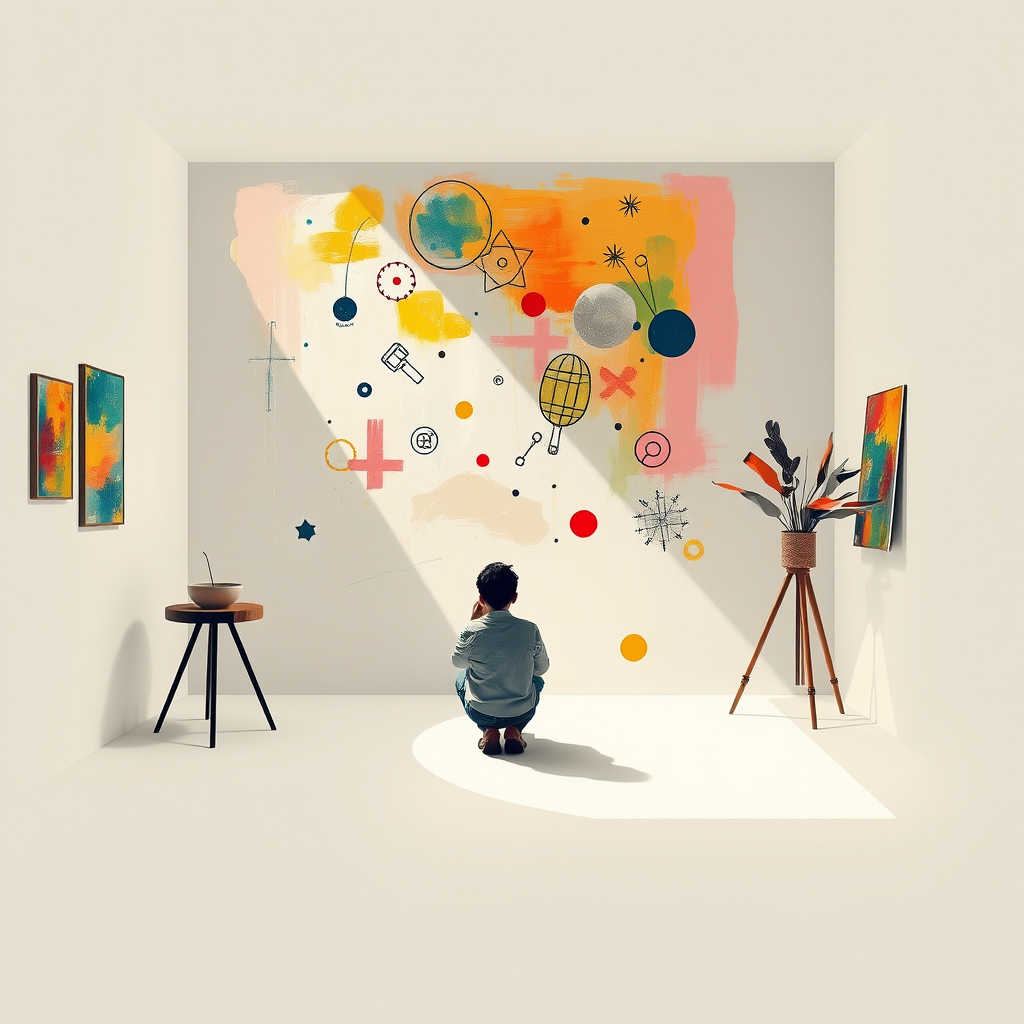
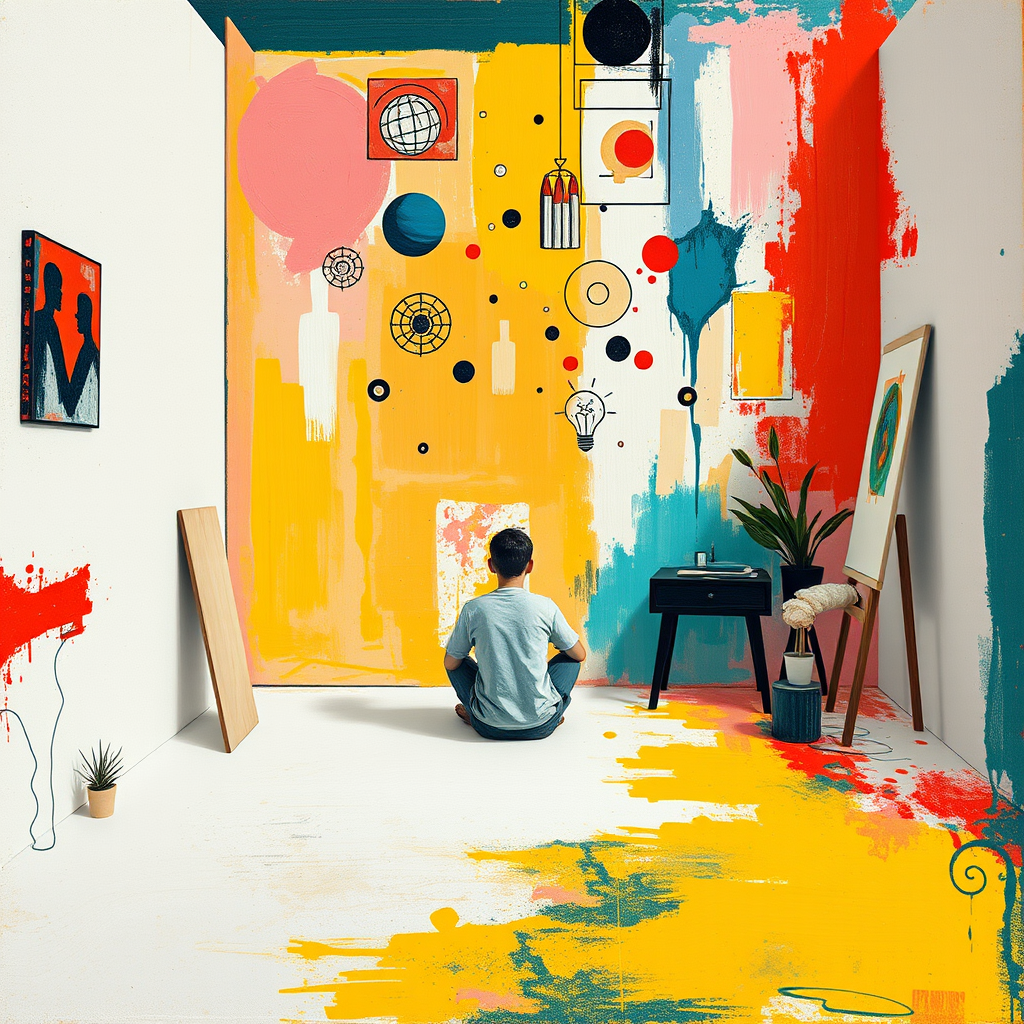
A person sitting alone in a quiet minimalist studio, deeply thinking while planning a conceptual artwork — floating symbols and abstract ideas around their head, soft ambient light, clean negative space, subtle surreal elements, muted color palette, artistic atmosphere, high-detail conceptual art style.
Recap (Q&A)
The concept is the starting point and the essence of the work.
The chosen medium must serve the idea, not the aesthetic.
Documentation and presentation complete the conceptual experience.
1. What does my idea express in its simplest form?
A conceptual core expressed in one clear sentence.
2. What is the most suitable vehicle for my idea?
The one that transmits the meaning directly, without unnecessary complication.
3. What will the audience understand from the encounter with the work?
Interpretation depends on the clarity of your intention and the way the work is presented.
Keywords / Key Phrases: idea as art, absence as form, concept before object
Category: CONCEPTUAL ART | Page updated on: November 26, 2025
Author: Arxonyus
Discover also in CONCEPTUAL ART: central idea
